Do Pets Understand Time? How Dogs and Cats Perceive Time Differently
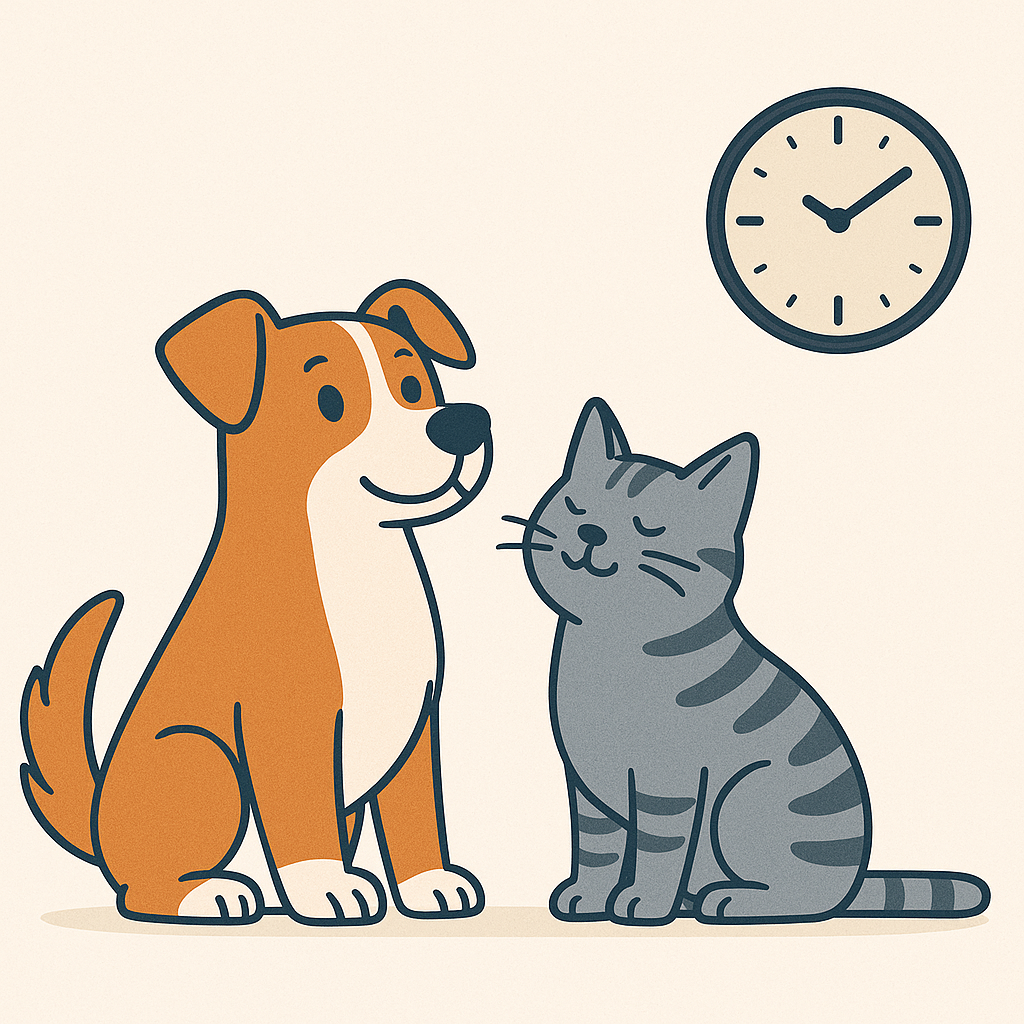
Do pets understand time? If you’ve ever returned home after just 15 minutes only to be greeted like a war hero by your dog — or if your cat appears next to the food bowl at the same hour every day — you’ve probably wondered whether your pet can tell time.
While dogs and cats don’t use clocks, studies show they do have a surprisingly refined sense of time. But they perceive it very differently from humans.
🧠 Do Pets Understand Time Through Memory and Routine?
Many pet owners wonder: do pets understand time the way we do — or is it something else entirely?
Animals do not understand time in a human sense. They don’t think in hours and minutes or track the passage of days like we do. Instead, their perception is event-based and biological.
Pets rely on:
- Circadian rhythms (internal biological clocks),
- Routine and repetition (consistent daily habits),
- Environmental cues (light, sound, temperature, smells).
For example, a dog might anticipate your return from work because of the way shadows fall in the afternoon, or how traffic sounds change outside. A cat may expect food not because it’s “6 PM,” but because the light from the window hits the wall a certain way at that time.
🧠 Do Pets Have Memory?
Yes — and it’s crucial to how they perceive time.
Pets form associative memories, meaning they remember patterns and outcomes:
- “When the food bag rustles, I get fed.”
- “When the leash appears, we go for a walk.”
But they do not have episodic memory like humans. Your dog won’t reminisce about “that amazing walk we had last summer.” They live in the moment — but their brains store patterns, which create the illusion of time awareness.
🐕 How Do Dogs Understand Time Compared to Humans?
Dogs are incredibly time-sensitive, especially when it comes to routines. In fact, dogs can become anxious or disoriented when their routine is disrupted.
Understanding how dogs behave helps answer the question: do pets understand time, or just routine?
Behavioral studies show that:
- Dogs are more excited when owners are gone longer (they can detect duration).
- They associate intervals with outcomes — like potty breaks, meals, and walks.
Some scientists even believe dogs can “smell” how long you’ve been gone, as scent molecules fade over time.
🐈 Do Cats Understand Time? Let’s Break It Down
Cats may seem indifferent, but they also track time — especially when food or comfort is involved.
If you’ve ever asked yourself, do pets understand time, your cat’s behavior around feeding hours might hold the answer.
Unlike dogs, who are people-pleasers, cats are schedule-keepers. Many cat owners notice their pets showing up like clockwork when it’s time to be fed or the sun hits their favorite napping spot.
Cats’ body clocks are remarkably accurate. Even indoor cats with minimal environmental variation still develop strong daily patterns.
📈 Why Understanding Time Matters for Pet Owners
Once we know how pets perceive time, we can:
- Improve their routines (predictability = comfort),
- Prevent behavioral issues (like separation anxiety),
- Tailor care to life stage (younger pets need stimulation, older ones need rest and regularity).
This deeper understanding helps us meet their emotional and physical needs better.
⌛ What About Aging? How Old Is My Pet Really?
Because time perception is so different, aging also feels different for pets. A 1-year-old dog is like a teenager. A 10-year-old large-breed dog may already be considered elderly.
But calculating exact “human years” equivalents depends on:
- Species (dog vs. cat),
- Size (especially for dogs),
- Breed-specific lifespan trends.
Want to know how old your pet really is — in human years?
👉 Try our free Pet Age Converter to discover your dog’s or cat’s “human age.” It’s a fun and insightful way to better understand where your pet is in their life journey.
🐾 Final Thoughts: Time Is Relative — Especially for Pets
So, do pets understand time in a human way? Not exactly — but their perception is incredibly rich in its own right.
Their world is built on moments, rhythms, and relationships. They don’t need a watch to know what matters.
And perhaps that’s a lesson for us too: to be more present, more consistent, and more mindful with our time — especially the time we share with them.
Curious about your pet’s life stage?
🎯 Check their human age with our Pet Age Converter →
